Mellar P. Davis, MD, FCCP, FAAHPM
Mary Lynn McPherson, MA, MDE, BCPS, CPE
Description
Description
A detailed review and update on Buprenorphine as well as a detailed look at the intra-cellular nuances of buprenorphine that makes this molecule so special.
This presentation is from BUPE2021, and CME credits are not available for it. However, it still has excellent learning value.
Presentation Slide Handouts: Presentation Handouts
The continued escalation of patients treated for opioid use disorder (OUD) has called for an increase in access to OUD therapies. Pharmacists have previously demonstrated value in collaborative treatment of various disease states and have recently begun to address gaps in OUD care by facilitating buprenorphine therapy. This presentation will review current literature describing the pharmacist’s role in facilitating buprenorphine as part of the OUD care team. Studies were included in the review if a pharmacist was part of a care model in which buprenorphine was prescribed for OUD and excluded if there was a pain management indication for therapy, a limited pharmacist role, or a survey methodology used. Key characteristics identified include: 1) Pharmacist Role 2) Collaborating Prescriber Type 3) Clinic Setting 4) Pharmacist Practice Type and 5) Outcomes. Findings revealed that pharmacists are a valued member of buprenorphine care teams across a variety of settings and have a positive impact on important patient outcomes such as treatment retention and relapse. Few published collaborative care models exist, suggesting pharmacists may be underutilized in caring for this expanding patient population. Pharmacists are well prepared to take a more active role in buprenorphine management to help address the enduring opioid crisis.
This presentation is from BUPE2021, and CME credits are not available for it. However, it still has excellent learning value.
Presentation Slide Handouts: Presentation Handouts
We report a case in which sublingual buprenorphine was used to help transition a patient off intravenous (IV) opioid analgesics medications post-multiple abdominal procedures. Intravenous opioids are commonly used in inpatient surgical pain management for patients with severe pain who are unable to take oral medications. Typically, a short course of IV analgesics is used, followed by transition to oral analgesic regimen. However, in patients with poor gastrointestinal absorption, pain control can be challenging. We present this case to highlight how sublingual buprenorphine can be a useful agent for acute pain management, especially when conventional strategies provide sub-optimal responses.
This presentation is from BUPE2021, and CME credits are not available for it. However, it still has excellent learning value.
Presentation Slide Handouts: Presentation Handouts
There is limited evidence and no clear consensus suggesting best practices for perioperative buprenorphine management in patients with opioid use disorder. As such, we aimed to develop a standardized perioperative management approach with the goals of (1) optimizing perioperative analgesia, (2) minimizing relapse risk, (3) setting expectations for patients and clinicians, (4) achieving prescribing consistency and mitigating risk among clinicians not familiar with perioperative buprenorphine management, and (5) maintaining continuity throughout care transitions. An interprofessional expert focus group convened to develop a consensus algorithm based upon buprenorphine’s unique pharmacologic features and published perioperative management recommendations. The resulting consensus algorithm continues the patient’s home buprenorphine dose in order to minimize relapse risk, but utilizes a divided dose approach starting the day of surgery if moderate to severe post-operative pain is expected. This strategy leverages the analgesic effects of buprenorphine while allowing for additional opioid binding to optimize analgesia. A patient-centered multimodal perioperative approach including local and/or regional anesthetics and nonopioid adjuncts is employed. Post-operative care is optimized by preoperative planning, including standardized patient assessment, perioperative communication with the buprenorphine prescriber, and education for patients and clinicians. Overall, integrating an understanding of pharmacology and clinical impact through the use of a readily adaptable algorithm
such as the divided dose approach is key to optimizing patient care in this high-risk population.
This presentation is from BUPE2021, and CME credits are not available for it. However, it still has excellent learning value.
1. Larochelle MR, Bernson D, Land T, et al.: Medication for opioid use disorder after nonfatal opioid overdose and association
with mortality: A cohort study. Ann Intern Med. 2018; 169: 137-145. DOI: 10.7326/M17-3107.
2. Mattick RP, Breen C, Kimber J, et al.: Buprenorphine maintenance versus placebo or methadone maintenance for opioid
dependence. Cochrane Database Syst Rev. 2014; 2: CD002207.
3. Atluri S, Sudarshan G, Manchikanti L: Assessment of the trends in medical use and misuse of opioid analgesics from
2004 to 2011. Pain Phys. 2014; 2(17): E119-E128.
4. Moore DJ: Nurse practitioners’ pivotal role in ending the opioid epidemic. J Nurs Pract. 2019; 15: 323-327.
5. HHS.gov: HHS expands access to treatment for opioid use disorder. 2021. Available at https://www.hhs.gov/about/
news/2021/01/14/hhs-expands-access-to-treatment-for-opioiduse-disorder.html. Accessed January 19, 2021.
Presentation Slide Handouts: Presentation Handouts
DOI: 10-5055-bupe-21-rp-0055
The chronic use of full opioid agonists presents risks to aging adults, especially since the longstanding use of opioids for chronic pain is associated with tolerance, along with opioid misuse, opioid use disorder (OUD), and inadvertent respiratory depression. Older adults are particularly at a high risk of complications given a higher prevalence of physical and mental health co-morbidities. Buprenorphine, used off-label for pain management, as a safer option, likely requires additional therapeutic resources to assist geriatric patients in this transition.
This presentation is from BUPE2021, and CME credits are not available for it. However, it still has excellent learning value.
Presentation Slide Handouts: Presentation Handouts
Poster – Evaluation of Strategies to Enhance Hospice Patient and Family’s Knowledge
and Confidence of Commonly Used Medications
Abby Stevens, PharmD1,2, Ryan Costantino PharmD, MS, BCPS, BCGP1, Mary Lynn McPherson, PharmD, MA, MDE, BCPS1
1 University of Maryland School of Pharmacy, 2 MedStar Health
Background:
Approximately 50% of the patient deaths of those enrolled in hospice care in 2018, died at home.1
• Twenty-three percent of informal caregivers (IFC) caring for patients in home hospice agreed it is difficult to decide which
analgesic to give, and 21% agreed it is difficult to decide what dose of analgesic medication to administer.2
• The Consumer Assessment of Healthcare Providers and Systems (CAHPS) hospice survey is distributed by the Centers
for Medicare and Medicaid (CMS) to informal caregivers after the death of a hospice patient to evaluate eight domains of
care: communication with family, getting timely help, treating patient with respect, emotional and spiritual support, help for
pain and symptoms, training family to care for patient, rating of the hospice, willingness to recommend the hospice.3
• Infographics provide complex information to various audiences in an easy to comprehend format with the use of pictures and
images.4
Keywords: hospice, caregiver, patient, family, palliative medicine, palliative care
Presentation Slide Handout: Poster Presentation PDF
DOI: 10.5055/bupe.21.pp.0095
References:
1. NHPCO Facts and Figures 2020 Edition. National Hospice and Palliative
Care Organization. 2020 Aug 20.
2. J Pain Symptom Manage. 2004;27(2):114-124.
3. CAHPS® Hospice Survey | CMS. Accessed April 11, 2021.
4. Chin Med J (Engl). 2018;131(20):2514-2517.
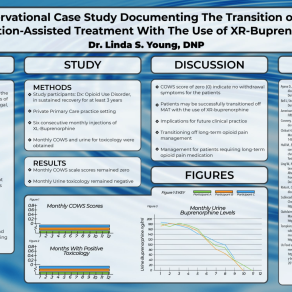
Poster – Limited Observational Case Study Documenting The Transition of Patients
Off Medication-Assisted Treatment With The Use of XR-Buprenorphine
Linda Young, DNP
Owner/Provider, Compassionate Care, Inc., North Smithfield, RI 02896
Abstract:
This was a limited observational case study, documenting the reported withdrawal symptoms of three Medication-assisted treatment (MAT) patients, after the cessation of subcutaneously injected XR (extended release) buprenorphine. The participants were two females ages 39 (participant A) and 37 (participant B) and one male 40 (participant C) years old. Each participant had a diagnosis of opioid use disorder (OUD), had at least three years of documented opioid cessation, were stable in all aspects of their lives and were requesting to be transitioned off MAT. The participants were given injections of XR-buprenorphine for six consecutive months and then the treatment was discontinued. Each participant met with the clinician monthly and a COWS (clinical opioid withdrawal scale) and a urine for toxicology was obtained. The female participants were followed for twelve and eleven months respectively and the male for nine months. The results of the COWS scores were zero (0) for all consecutive months of the study and the urine tox screens were negative for opioid use for all consecutive months, for all three participants. Although the results of this case study are limited, they do indicate that the use of XR-buprenorphine to transition patients off MAT may be a novel and innovative way to assist stable patients with reclaiming their previously opioid free lives.
Keywords: Medication-assisted treatment, XR-buprenorphine, opioid use disorder, buprenorphine
Presentation Slide Handout: Poster Presentation Handouts
DOI: 10.5055/bupe.21.pp.0090
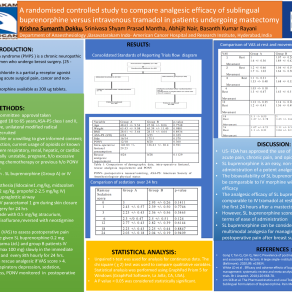
Poster – A randomised controlled study to compare analgesic efficacy of sublingual buprenorphine
versus intravenous tramadol in patients undergoing mastectomy
Krishna Sumanth Dokku, Srinivasa Shyam Prasad Mantha, Abhijit Nair, Basanth Kumar Rayani
Department of Anaesthesiology, Basavatarakam Indo- American Cancer Hospital and Research Institute, Hyderabad, India
Abstract:
Sublingual (SL) buprenorphine has been used by researchers to manage acute postoperative pain. In this study, we compared analgesic efficacy of SL buprenorphine to intravenous tramadol in managing postoperative pain after mastectomy.
Postmastectomy pain syndrome (PMPS) is a chronic neuropathic pain observed in women who undergo breast surgery. Poorly managed postoperative pain after breast surgery is one of the important causes of PMPS. Buprenorphine is available for clinical use in the form of sublingual (SL) tablets which have been used for managing acute postoperative pain with reasonable success.
Presentation Slide Handout: Poster Presentation
DOI: 10.5055/bupe.21.pp.0085
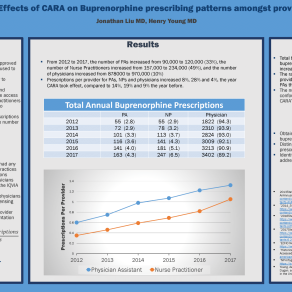
Poster – The Effects of CARA on Buprenorphine prescribing patterns amongst providers
Jonathan Liu MD, Henry Young MD
Abstract:
Background: Buprenorphine is a mainstay of FDA approved Medication Assisted Treatment (MAT) used to treat OUD. Access remains a barrier to widespread treatment.
Purpose: In 2016, CARA sought to increase MAT access by allowing waivered Nurse Practitioners (NPs) and Physician Assistants (PAs) to prescribe buprenorphine for MAT. NP and PA written prescriptions have increased annually alongside the number of licensed providers. Unclear is whether increasing prescriptions can be attributed to each provider prescribing more, an increase in providers, or both. We examined the effects of CARA on prescribing patterns among advanced practice providers.
Procedures: The number of buprenorphine prescriptions written in the US by NPs, PAs, and physicians from 2012-2017 was collected using the IQVIA database, which represents 92% of all US retail prescriptions. The number of providers was obtained from the providers’ respective licensing agencies. Descriptive statistics were used to analyze the data. Prescriptions per provider for PAs, NPs and physicians and physicians increased 8%, 28% and 4%, the year CARA took effect, compared to 14%, 19% and 9% the year before.
Conclusions: Total buprenorphine prescriptions and buprenorphine prescriptions per provider increased annually for all provider types. However, the prescriptions per provider increased for NPs, but decreased for PAs the year CARA was implemented.
Presentation Slide Handout: Poster Presentation PDF
DOI: 10.5055/bupe.21.pp.0080