BUPE2024.COMBUPE2024.COM
  • Home
  • Presentations
  • Posters
  • Info
    • ——————————
      • Call For Presentations, Posters, etc
      • CME/CPE Information
        • Conference Chairs
    • ——————————
      • Contact Us
      • Speakers
    • ——————————
      • Conference Information
      • Terms and conditions
      • Tickets
    • ——————————
      • Educational Support
      • Sponsorship & Exhibits
  • Register Now to Watch
  • Login
  • Get Started Now!
  • Home
  • Presentations
  • Posters
  • Info
    • ——————————
      • Call For Presentations, Posters, etc
      • CME/CPE Information
        • Conference Chairs
    • ——————————
      • Contact Us
      • Speakers
    • ——————————
      • Conference Information
      • Terms and conditions
      • Tickets
    • ——————————
      • Educational Support
      • Sponsorship & Exhibits
  • Register Now to Watch
  • Login
  • Get Started Now!

Video

Acampora_BUPE2021 Slide 1
01/182022

Encore BUPE2021: Buprenorphine Update – Intracellular Nuances of Buprenorphine

Presentations, Presentations for CME Review 1
https://bupe2021.com/wp-content/uploads/2020/06/Acampora_Final_Video.mp4

CLICK HERE for Live Video Presentation December 16, 2021 at 2:30pmET

Buprenorphine Update – Intracellular Nuances of Buprenorphine

Gregory Acampora, MD

A detailed review and update on Buprenorphine as well as a detailed look at the intra-cellular nuances of buprenorphine that makes this molecule so special.

This presentation is from BUPE2021, and CME credits are not available for it. However, it still has excellent learning value.

Presentation Slide Handouts: Presentation Handouts
Read more
Pharmacists Role in Buprenorphine Management in Opioid Slide 1 PDF
01/162022

Encore BUPE2021: Pharmacists Role in Buprenorphine Management for Opioid Use Disorder

Presentations, Presentations for CME Review
https://bupe2021.com/wp-content/uploads/2020/06/Cleary-Engle_Final_Video.mp4

Pharmacists Role in Buprenorphine Management for Opioid Use Disorder

Jacqueline Cleary, PharmD, BCACP
Amanda Winans, PharmD, BCPS
Amanda Engle, PharmD, BCPS

The continued escalation of patients treated for opioid use disorder (OUD) has called for an increase in access to OUD therapies. Pharmacists have previously demonstrated value in collaborative treatment of various disease states and have recently begun to address gaps in OUD care by facilitating buprenorphine therapy. This presentation will review current literature describing the pharmacist’s role in facilitating buprenorphine as part of the OUD care team. Studies were included in the review if a pharmacist was part of a care model in which buprenorphine was prescribed for OUD and excluded if there was a pain management indication for therapy, a limited pharmacist role, or a survey methodology used. Key characteristics identified include: 1) Pharmacist Role 2) Collaborating Prescriber Type 3) Clinic Setting 4) Pharmacist Practice Type and 5) Outcomes. Findings revealed that pharmacists are a valued member of buprenorphine care teams across a variety of settings and have a positive impact on important patient outcomes such as treatment retention and relapse. Few published collaborative care models exist, suggesting pharmacists may be underutilized in caring for this expanding patient population. Pharmacists are well prepared to take a more active role in buprenorphine management to help address the enduring opioid crisis.

This presentation is from BUPE2021, and CME credits are not available for it. However, it still has excellent learning value.

Presentation Slide Handouts: Presentation Handouts
Read more
BUPE2021presentation_TEP092721_YZ edit Slide1
01/152022

Encore BUPE2021: Facilitating discontinuation of intravenous opioids by concurrent use of sublingual buprenorphine with rapid microdosing induction: A pain management case study

Presentations, Presentations for CME Review
https://bupe2021.com/wp-content/uploads/2020/06/Taylor_Purvis_Final_Video.mp4


Facilitating discontinuation of intravenous opioids by concurrent use of sublingual buprenorphine
with rapid microdosing induction: A pain management case study

Taylor Purvis, MD
Co-authors on the original paper: Arjun Tara, DO; Gregory Acampora, MD; Jingping Wang, MD, PhD; Karina De Sousa, BS; Yi Zhang, MD, PhD

We report a case in which sublingual buprenorphine was used to help transition a patient off intravenous (IV) opioid analgesics medications post-multiple abdominal procedures. Intravenous opioids are commonly used in inpatient surgical pain management for patients with severe pain who are unable to take oral medications. Typically, a short course of IV analgesics is used, followed by transition to oral analgesic regimen. However, in patients with poor gastrointestinal absorption, pain control can be challenging. We present this case to highlight how sublingual buprenorphine can be a useful agent for acute pain management, especially when conventional strategies provide sub-optimal responses.

This presentation is from BUPE2021, and CME credits are not available for it. However, it still has excellent learning value.

Presentation Slide Handouts: Presentation Handouts
Read more
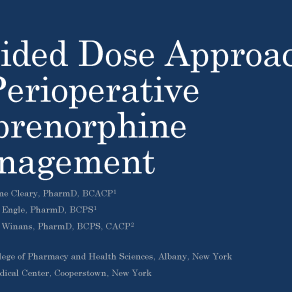
Divided Dose Approach Cleary et al_FINAL BUPE2021 Periop Management Div Dose App_Final Slide 1
01/142022

Encore BUPE2021: The divided dose approach to perioperative buprenorphine management in patients with opioid use disorder

Presentations, Presentations for CME Review
https://bupe2021.com/wp-content/uploads/2020/06/Divided-Dose-Approach-Cleary-et-al.mp4


The divided dose approach to perioperative buprenorphine management in patients with opioid use disorder

Amanda L. Engle, PharmD, Amanda R.M. Winans, PharmD, Linda Demma, MD, PhD, Jacqueline Cleary, PharmD

There is limited evidence and no clear consensus suggesting best practices for perioperative buprenorphine management in patients with opioid use disorder. As such, we aimed to develop a standardized perioperative management approach with the goals of (1) optimizing perioperative analgesia, (2) minimizing relapse risk, (3) setting expectations for patients and clinicians, (4) achieving prescribing consistency and mitigating risk among clinicians not familiar with perioperative buprenorphine management, and (5) maintaining continuity throughout care transitions. An interprofessional expert focus group convened to develop a consensus algorithm based upon buprenorphine’s unique pharmacologic features and published perioperative management recommendations. The resulting consensus algorithm continues the patient’s home buprenorphine dose in order to minimize relapse risk, but utilizes a divided dose approach starting the day of surgery if moderate to severe post-operative pain is expected. This strategy leverages the analgesic effects of buprenorphine while allowing for additional opioid binding to optimize analgesia. A patient-centered multimodal perioperative approach including local and/or regional anesthetics and nonopioid adjuncts is employed. Post-operative care is optimized by preoperative planning, including standardized patient assessment, perioperative communication with the buprenorphine prescriber, and education for patients and clinicians. Overall, integrating an understanding of pharmacology and clinical impact through the use of a readily adaptable algorithm
such as the divided dose approach is key to optimizing patient care in this high-risk population.

This presentation is from BUPE2021, and CME credits are not available for it. However, it still has excellent learning value.

1. Larochelle MR, Bernson D, Land T, et al.: Medication for opioid use disorder after nonfatal opioid overdose and association
with mortality: A cohort study. Ann Intern Med. 2018; 169: 137-145. DOI: 10.7326/M17-3107.
2. Mattick RP, Breen C, Kimber J, et al.: Buprenorphine maintenance versus placebo or methadone maintenance for opioid
dependence. Cochrane Database Syst Rev. 2014; 2: CD002207.
3. Atluri S, Sudarshan G, Manchikanti L: Assessment of the trends in medical use and misuse of opioid analgesics from
2004 to 2011. Pain Phys. 2014; 2(17): E119-E128.
4. Moore DJ: Nurse practitioners’ pivotal role in ending the opioid epidemic. J Nurs Pract. 2019; 15: 323-327.
5. HHS.gov: HHS expands access to treatment for opioid use disorder. 2021. Available at https://www.hhs.gov/about/
news/2021/01/14/hhs-expands-access-to-treatment-for-opioiduse-disorder.html. Accessed January 19, 2021.

Presentation Slide Handouts: Presentation Handouts


DOI: 10-5055-bupe-21-rp-0055

Read more
Pages from BUPE21 Pain Mgmt in Older Adults and Integrative Health Oct08_slide1 - Copy
01/132022

Encore BUPE2021: Managing the Complexities of Treating Older Adults with Longstanding Chronic Pain or Opioid Use Disorder with Buprenorphine and Integrative Health

Presentations, Presentations for CME Review
https://bupe2021.com/wp-content/uploads/2020/06/Perzhinsky_Video.mp4


Managing the Complexities of Treating Older Adults with Longstanding Chronic Pain
or Opioid Use Disorder with Buprenorphine and Integrative Health

Juliette Perzhinsky, MD, MSc, FACP
John Hopper, MD, DFASAM, FACP, FAAP
David Gaffney, LMSW, BCDCH

The chronic use of full opioid agonists presents risks to aging adults, especially since the longstanding use of opioids for chronic pain is associated with tolerance, along with opioid misuse, opioid use disorder (OUD), and inadvertent respiratory depression. Older adults are particularly at a high risk of complications given a higher prevalence of physical and mental health co-morbidities. Buprenorphine, used off-label for pain management, as a safer option, likely requires additional therapeutic resources to assist geriatric patients in this transition.

This presentation is from BUPE2021, and CME credits are not available for it. However, it still has excellent learning value.

Presentation Slide Handouts: Presentation Handouts
Read more
AStevens Hospice Education Poster 12.15_150DPI
12/152021

Encore BUPE2021: Evaluation of Strategies to Enhance Hospice Patient and Family’s Knowledge and Confidence of Commonly Used Medications

Posters
https://bupe2021.com/wp-content/uploads/2020/06/AStevens-poster-video_final.mp4


Poster – Evaluation of Strategies to Enhance Hospice Patient and Family’s Knowledge
and Confidence of Commonly Used Medications

Abby Stevens, PharmD1,2, Ryan Costantino PharmD, MS, BCPS, BCGP1, Mary Lynn McPherson, PharmD, MA, MDE, BCPS1
1 University of Maryland School of Pharmacy, 2 MedStar Health

Background:

Approximately 50% of the patient deaths of those enrolled in hospice care in 2018, died at home.1
• Twenty-three percent of informal caregivers (IFC) caring for patients in home hospice agreed it is difficult to decide which
analgesic to give, and 21% agreed it is difficult to decide what dose of analgesic medication to administer.2
• The Consumer Assessment of Healthcare Providers and Systems (CAHPS) hospice survey is distributed by the Centers
for Medicare and Medicaid (CMS) to informal caregivers after the death of a hospice patient to evaluate eight domains of
care: communication with family, getting timely help, treating patient with respect, emotional and spiritual support, help for
pain and symptoms, training family to care for patient, rating of the hospice, willingness to recommend the hospice.3
• Infographics provide complex information to various audiences in an easy to comprehend format with the use of pictures and
images.4

Keywords: hospice, caregiver, patient, family, palliative medicine, palliative care

Presentation Slide Handout: Poster Presentation PDF

DOI: 10.5055/bupe.21.pp.0095

References:

1. NHPCO Facts and Figures 2020 Edition. National Hospice and Palliative
Care Organization. 2020 Aug 20.
2. J Pain Symptom Manage. 2004;27(2):114-124.
3. CAHPS® Hospice Survey | CMS. Accessed April 11, 2021.
4. Chin Med J (Engl). 2018;131(20):2514-2517.

Read more
LINDA YOUNG BUPE2021 Poster Presentation Slide 1
12/082021

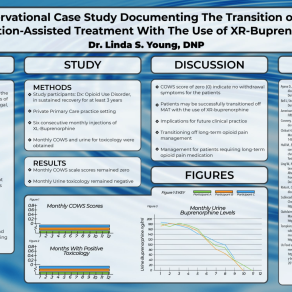
Encore BUPE2021: Limited Observational Case Study Documenting The Transition of Patients Off Medication-Assisted Treatment With The Use of XR-Buprenorphine

Posters
https://bupe2021.com/wp-content/uploads/2020/06/Young-Final-Poster-Presentation.mp4

Poster – Limited Observational Case Study Documenting The Transition of Patients
Off Medication-Assisted Treatment With The Use of XR-Buprenorphine

Linda Young, DNP
Owner/Provider, Compassionate Care, Inc., North Smithfield, RI 02896

Abstract:

This was a limited observational case study, documenting the reported withdrawal symptoms of three Medication-assisted treatment (MAT) patients, after the cessation of subcutaneously injected XR (extended release) buprenorphine. The participants were two females ages 39 (participant A) and 37 (participant B) and one male 40 (participant C) years old. Each participant had a diagnosis of opioid use disorder (OUD), had at least three years of documented opioid cessation, were stable in all aspects of their lives and were requesting to be transitioned off MAT. The participants were given injections of XR-buprenorphine for six consecutive months and then the treatment was discontinued. Each participant met with the clinician monthly and a COWS (clinical opioid withdrawal scale) and a urine for toxicology was obtained. The female participants were followed for twelve and eleven months respectively and the male for nine months. The results of the COWS scores were zero (0) for all consecutive months of the study and the urine tox screens were negative for opioid use for all consecutive months, for all three participants. Although the results of this case study are limited, they do indicate that the use of XR-buprenorphine to transition patients off MAT may be a novel and innovative way to assist stable patients with reclaiming their previously opioid free lives.

Keywords: Medication-assisted treatment, XR-buprenorphine, opioid use disorder, buprenorphine

Presentation Slide Handout: Poster Presentation Handouts

DOI: 10.5055/bupe.21.pp.0090


Read more
BUPE2021 Poster -Dr Krishna S Dokku Slide
11/102021

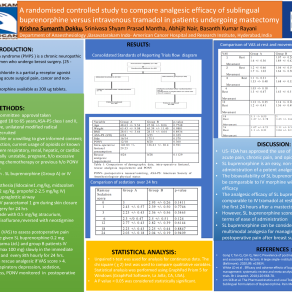
Encore BUPE20201: Poster – A randomised controlled study to compare analgesic efficacy of sublingual buprenorphine versus intravenous tramadol in patients undergoing mastectomy

Posters
https://bupe2021.com/wp-content/uploads/2020/06/BUPE2021-Dr-Krishna-S-Dokku.mp4

Poster – A randomised controlled study to compare analgesic efficacy of sublingual buprenorphine
versus intravenous tramadol in patients undergoing mastectomy

Krishna Sumanth Dokku, Srinivasa Shyam Prasad Mantha, Abhijit Nair, Basanth Kumar Rayani
Department of Anaesthesiology, Basavatarakam Indo- American Cancer Hospital and Research Institute, Hyderabad, India

Abstract:

Sublingual (SL) buprenorphine has been used by researchers to manage acute postoperative pain. In this study, we compared analgesic efficacy of SL buprenorphine to intravenous tramadol in managing postoperative pain after mastectomy.

Postmastectomy pain syndrome (PMPS) is a chronic neuropathic pain observed in women who undergo breast surgery. Poorly managed postoperative pain after breast surgery is one of the important causes of PMPS. Buprenorphine is available for clinical use in the form of sublingual (SL) tablets which have been used for managing acute postoperative pain with reasonable success.

Presentation Slide Handout: Poster Presentation

DOI: 10.5055/bupe.21.pp.0085


Read more
Jonathan Liu Bup Poster Powerpoint
11/082021

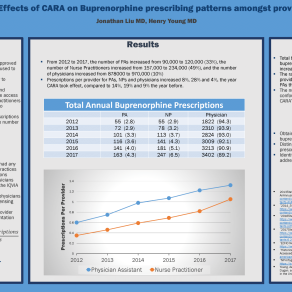
Encore BUPE2021: Poster – The Effects of CARA on Buprenorphine prescribing patterns amongst providers

Posters
https://bupe2021.com/wp-content/uploads/2020/06/Liu-Poster-Presentation.mp4

Poster – The Effects of CARA on Buprenorphine prescribing patterns amongst providers

Jonathan Liu MD, Henry Young MD

Abstract:

Background: Buprenorphine is a mainstay of FDA approved Medication Assisted Treatment (MAT) used to treat OUD. Access remains a barrier to widespread treatment.

Purpose: In 2016, CARA sought to increase MAT access by allowing waivered Nurse Practitioners (NPs) and Physician Assistants (PAs) to prescribe buprenorphine for MAT. NP and PA written prescriptions have increased annually alongside the number of licensed providers. Unclear is whether increasing prescriptions can be attributed to each provider prescribing more, an increase in providers, or both. We examined the effects of CARA on prescribing patterns among advanced practice providers.

Procedures: The number of buprenorphine prescriptions written in the US by NPs, PAs, and physicians from 2012-2017 was collected using the IQVIA database, which represents 92% of all US retail prescriptions. The number of providers was obtained from the providers’ respective licensing agencies. Descriptive statistics were used to analyze the data. Prescriptions per provider for PAs, NPs and physicians and physicians increased 8%, 28% and 4%, the year CARA took effect, compared to 14%, 19% and 9% the year before.

Conclusions: Total buprenorphine prescriptions and buprenorphine prescriptions per provider increased annually for all provider types. However, the prescriptions per provider increased for NPs, but decreased for PAs the year CARA was implemented.

Presentation Slide Handout: Poster Presentation PDF

DOI: 10.5055/bupe.21.pp.0080


Read more
Hannah Epstein Presentations Screen Shot
11/032021

Encore BUPE2021: Interest in long-acting injectable buprenorphine among syringe services program participants – Preview

Presentations

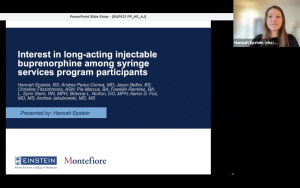
Interest in long-acting injectable buprenorphine among syringe services program participants

Hannah Epstein, BS;
Andres Perez-Correa, MD;
Jason Beltre, BS;
Christine Fitzsimmons, ASN;
Pia Marcus, BA;
Franklin Ramirez, BA;
L. Synn Stern, RN, MPH;
Brianna L. Norton, DO, MPH;
Aaron D. Fox, MD, MS;
Andrea Jakubowski, MD, MS

This presentation is from BUPE2021, and CME credits are not available for it. However, it still has excellent learning value.

Objective: To examine syringe services program (SSP) participants’ interest in long-acting injectable buprenorphine.
Design: SSP participants completed a 136-item questionnaire by phone. Items assessed quantitative ratings of interest in sublingual and injectable buprenorphine, preference for sublingual versus injectable buprenorphine, and reasons for preferences.
Setting: Two large urban SSPs.
Participants: SSP participants ≥18 years of age with current or lifetime opioid use disorder (OUD).
Main outcome measure(s): (1) Interest in sublingual and injectable buprenorphine, respectively, on a scale from 0 to 10 (0 = no interest and 10 = high interest); and (2) preference for sublingual buprenorphine versus injectable buprenorphine. Participants were also asked whether they agreed with statements that presented potential reasons for preferring each formulation.
Results: A total of 104 unique participants were interviewed, of which 72 (69 percent) were currently receiving or considering buprenorphine treatment. Among these 72 participants, the median level of interest in starting or continuing sublingual buprenorphine was 8 out of 10 (interquartile range [IQR]: 6-10) and in starting injectable buprenorphine was 5 out of 10 (IQR: 1-9). Thirty-six (50 percent) preferred sublingual, 27 (38 percent) preferred injectable, and 9 (13 percent) preferred neither or declined to answer. Participants who preferred injectable buprenorphine most commonly agreed that the convenience of the monthly injection was the reason for their preference.
Conclusions: Among SSP participants with OUD, we found moderate interest in injectable buprenorphine. Introducing this new form of buprenorphine treatment at SSPs could help meet the needs of individuals who are not well-served by standard OUD treatment models.

Presentation Slide Handouts:

Read more
Older Entries
Newer Entries
Search
Latest Presentations
  • Buprenorphine: Not Just Another Opioid – Understanding the World’s Most Interesting Opioid
  • Impact of an Education Module on the Knowledge and Attitudes of EM Physicians Towards Prescribing Buprenorphine / Naloxone for Opioid Use Disorder
  • Buprenorphine for Cancer Pain: Results from a Systematic Review
  • Buprenorphine: Opioid Agonist-Antagonist Benefits for Opioid Resistant Pain Uncontrolled By Full-Agonist Opioids during Hematopoietic Stem Cell Transplant for Sickle Cell Disease
Categories
  • Posters
  • Presentations
  • Presentations for CME Review

Journal of Opioid Management (JOM) has assembled the best and brightest minds in opioid analgesics who will explore the benefits and challenges of using buprenorphine to treat patients across the spectrum.

BUPE2024/2025 is presented by the Journal of Opioid Management. We are dedicated to presenting the latest research and practice for managing patients on opioid therapies.

INFORMATION
  • Terms and conditions
  • Privacy Statement
Looking for more? Sign up today!

    Contact Us
    jom@pnpco.com
    Copyright 2023-2025 Weston Medical Publishing, LLC - All Rights Reserved
    This website uses cookies to improve your experience. We'll assume you're ok with this, but you can opt-out if you wish. Cookie settingsACCEPT
    Privacy & Cookies Policy

    Privacy Overview

    Privacy Statement


    Privacy and User Data Policy

    GDPR Update:

    The data collected from registered and non-registered users of this journal falls within the scope of the standard functioning of peer-reviewed journals. It includes information that makes communication possible for the editorial process; it is used to informs readers about the authorship and editing of content; it enables collecting aggregated data on readership behaviors, as well as tracking geopolitical and social elements of scholarly communication.

    This journal’s editorial team uses this data to guide its work in publishing and improving this journal. Data that will assist in developing this publishing platform may be shared with its developer Public Knowledge Project in an anonymized and aggregated form, with appropriate exceptions such as article metrics. The data will not be sold by this journal or PKP nor will it be used for purposes other than those stated here. The authors published in this journal are responsible for the human subject data that figures in the research reported here.

    Those involved in editing this journal seek to be compliant with industry standards for data privacy, including the European Union’s General Data Protection Regulation (GDPR) provision for “data subject rights” that include (a) breach notification; (b) right of access; (c) the right to be forgotten; (d) data portability; and (e) privacy by design. The GDPR also allows for the recognition of “the public interest in the availability of the data,” which has a particular saliency for those involved in maintaining, with the greatest integrity possible, the public record of scholarly publishing.

    Requests per item (a) through (e) above should be sent to the journal's mailbox, jom(at)pnpco.com

    The names and email addresses entered in this journal site will be used exclusively for the stated purposes of this journal and will not be made available for any other purpose or to any other party.

    What Data does this Website Process?

    The system, based the PKP Open Journal System applications, process personal data as a fundamental part of their operations. Most data is only provided by consent, ie. through manual user registration, though some visitation data (eg. cookies, usage logs) may also be recorded.

    User Registration Data

    When a visitor creates a user account in a PKP application, the following personal information is processed and stored (with some minor variation between OMP and OJS, and from version to version):

    ●   Salutation

    ●   First name*

    ●   Middle name

    ●   Last name*

    ●   Suffix

    ●   Username

    ●   Gender

    ●   Password (encrypted)

    ●   Email address*

    ●   ORCiD ID

    ●   Website

    ●   Mailing Address

    ●   Country

    ●   Phone

    ●   Fax

    ●   Affiliation

    ●   Biography

    ●   Registration date

    ●   Last login date

    ●   Locales

    ●   Reviewing interests

    ●   Role registrations (author, reader, and/or reviewer)

    Only the username, first name, last name, email and password fields are required.

    Storage

    This information is stored in the application database. Only the user password

    is encrypted.

    Availability and Access

    This information is available to the user via their User Profile (and, with the exception of the username and dates, can be edited). System administrators, journal managers, and editors can also access and edit this data (except the username and dates) via the application back end. The data can be downloaded by journal managers in XML format. The data is not otherwise publicly available.

    Erasure

    This data can be erased by the journal manager using the Merge Users tool, without affecting any editorial records. The erasure is subject to the considerations raised in the section “Scholarly Publishing, Data Privacy, and the Public Interest”, above.

    Contributor Metadata Information

    When a manuscript is submitted to a PKP application, contributor information is included. Contributors can be authors, translators, volume editors, and so on. This information is stored as submission metadata and is provided as part of any published manuscript record. The following contributor information is collected:

    ●   Salutation

    ●   First name*

    ●   Middle name

    ●   Last name*

    ●   Email address*

    ●   Suffix

    ●   ORCiD ID

    ●   Website

    ●   Country*

    ●   Affiliation

    ●   Biography

    Only the first name, last name, email address and country fields are required.

    Storage

    This information is stored in the application database.

    Data Transfer

    We do not sell or transfer to third parties user information from this system.

    General Visitor Information

    PKP applications also collect general visitor usage data, including:

    ● Cookie information, to manage session history. Cookies are required to maintain a login session in PKP applications.

    ● Optionally, detailed usage log data, including: IP address; pages visited; date visited; and browser information, in application log files, as part of the Usage Statistics plugin. An anonymization option is available to privatize this information.

    ● Optionally, country, region and city information, in the metrics database. This data collection requires additional setup and is not enabled by default.

    Other data may be tracked, either on the server or via third parties:

    ● Script loads from CDN servers;

    ● IP address information (including date, browser, etc.) in web server logs (separate from application log files as part of the Usage Statistics plugin).

    Detailed instructions in limiting the amount of data you collect, and providing consent for the data you collect, can be found below.

    Storage

    ● Cookies: A cookie (usually titled “OJSSID” or “OMPSID”) is created when first visiting a PKP application and is stored on the visitor’s computer. It is only used to store a session ID, and to facilitate logins. (If the visitor blocks cookies, OJS will still work properly, though they will not be able to log in.)

    ● Usage Statistics log files: As part of the usage statistics framework and plugin, OJS may store detailed application log files in the submission files directory (configured as the files_dir parameter in the OJS config.inc.php file), in a “usageStats” directory.

    ● Geographical data: Filtered usage data, including possibly geographic data, is also stored in the OJS database, in a “metrics” table.

    Availability and Access

    ● Cookies: These are available via the visitor’s browser settings.

    ● Usage Statistics log files: Only individuals with server file access can access application log files.

    ● Geographical data: Journal Managers can access filtered usage data by using the OJS usage report plugins.

    Erasure

    ● Cookies: These can be deleted via the visitor browser.

    ● Usage Statistics log files: These can be erased by system administrators with file access.

    ● Geographical data: This can only be erased by deleting records from the database directly, which also typically requires system administrator access.

    Portions of this privacy statement are copyright by Simon Fraiser University Licensed wth CC4.0-BY.
    Necessary
    Always Enabled
    Necessary cookies are absolutely essential for the website to function properly. This category only includes cookies that ensures basic functionalities and security features of the website. These cookies do not store any personal information.
    Non-necessary
    Any cookies that may not be particularly necessary for the website to function and is used specifically to collect user personal data via analytics, ads, other embedded contents are termed as non-necessary cookies. It is mandatory to procure user consent prior to running these cookies on your website.
    SAVE & ACCEPT